
Partition of 1947
During the partition of India in 1947, over 562 princely states were given the option to join either Pakistan or India or remain independent.
Jammu & Kashmir was a Muslim-majority state, but its ruler, Maharaja Hari Singh, was Hindu. Initially, he decided to remain independent. However, in October 1947, a rebellion broke out in the Poonch area, and tribal fighters entered from Khyber Pakhtunkhwa, changing the situation. Maharaja Hari Singh sought military assistance from India.
India agreed to send troops in exchange for the Instrument of Accession, officially making Kashmir part of India. Pakistan rejected this move.
First Pakistan–India War (1947–48)
At the time of the tribal invasion and India’s occupation of Kashmir, Pakistan’s first Commander-in-Chief General Sir Frank Walter Messervy was in London. India claimed the tribal attack was conducted with Pakistan’s approval. On 12 November 1947, Messervy clarified in a letter that no serving Pakistani military personnel were involved, and Pakistan submitted this letter as evidence to the United Nations.
Later, General Douglas Gracey served as Pakistan’s second Commander-in-Chief from 11 February 1948 to 16 January 1951. Initially, he refused to send Pakistani troops to Kashmir on the orders of Quaid-e-Azam, keeping British officers neutral. However, in 1948, Pakistani troops entered Kashmir, and the war continued.
United Nations Intervention
In January 1948, India raised the Kashmir issue at the United Nations. The UN proposed ceasefire and a referendum so that the people of Kashmir could decide whether to join Pakistan or India.
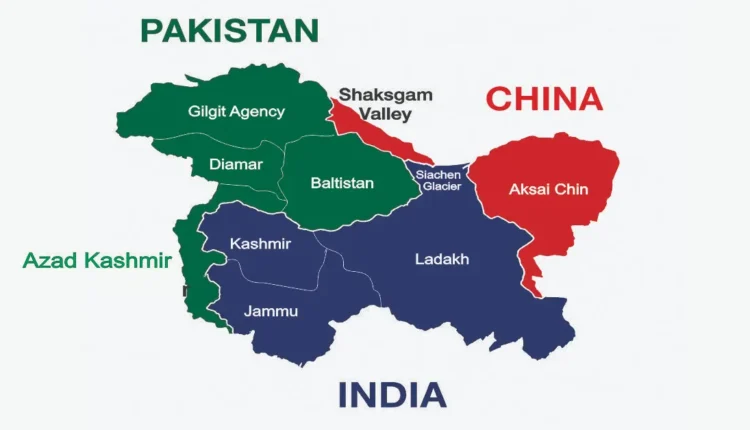
- On 1 January 1949, the ceasefire came into effect, and Kashmir was divided into:
- Pakistan-administered Kashmir: Azad Kashmir and Gilgit-Baltistan
- India-administered Kashmir: Jammu & Kashmir, Ladakh, and Aksai Chin
Impact of the 1962 China–India War
After the 1962 China–India war, Aksai Chin, part of Indian-administered Kashmir, came under Chinese control. This split Kashmir among three countries.
China–Pakistan Border Agreement (1963)
In 1963, Pakistan ceded the Shaksgam Valley to China to resolve border disputes and strengthen bilateral ties. This area was north of Gilgit-Baltistan and not under Pakistan’s control at the time. Under the agreement, China also ceded some territory to Pakistan, with a provision to review borders if the Kashmir issue was resolved.
Second Pakistan–India War (1965) & Tashkent Agreement
The 1965 war also failed to resolve the Kashmir issue. Under Soviet mediation, the Tashkent Agreement was signed on 10 January 1966 in Tashkent (now Uzbekistan).
- Pakistan’s delegation was led by President Ayub Khan.
- India’s delegation was led by Prime Minister Lal Bahadur Shastri, who tragically died of a heart attack immediately after the agreement in Tashkent.
Third Pakistan–India War (1971) & Shimla Agreement
The 1971 Shimla Agreement was signed in Shimla, India, where both countries agreed on the Line of Control (LoC).
- The 1949 UN-monitored ceasefire line was renamed the Line of Control after the 1971 war, with some modifications.
India’s Occupation of Siachen
In April 1984, during General Zia-ul-Haq’s era, India launched Operation Meghdoot and occupied the Siachen Glacier.
- India captured key peaks and passes, while Pakistan had no permanent presence there due to unclear boundaries.
- Since then, Siachen has been the world’s highest and most challenging battlefield, with Pakistan and India facing each other.
Kargil War (Fourth Pakistan–India War, 1999)
From May to July 1999, the Kargil War occurred in the Kargil sector of Kashmir.
- Pakistani troops and Kashmiri militants occupied high peaks in Indian-administered areas.
- India launched ground and air operations to reclaim the territory.
- Under international pressure, Pakistan withdrew its forces by July 1999.
Later, Prime Minister Nawaz Sharif claimed that the operation had been initiated by General Pervez Musharraf without his approval.
February 2019 Tensions
After the Pulwama attack, India conducted an airstrike on Balakot (Mansehra District, KP) on 26 February 2019.
- Pakistan retaliated, striking near Indian territory and downing two Indian aircraft, capturing pilot Abhinandan, who was later released.
- Fighting subsided after several days, but relations remained tense.
India’s August 5, 2019 Move
India revoked Articles 370 and 35A of its constitution, ending Jammu & Kashmir’s special status and splitting it into two Union Territories:
- Jammu & Kashmir
- Ladakh
May 2025 Clashes
On 6 May 2025, following the Pahalgam attack, Pakistan and India engaged in intense military clashes involving drones, missiles, airstrikes, and heavy statements.
- A temporary ceasefire was brokered by US President Donald Trump.
- India called its operation Operation Sindhur, and Pakistan responded with Operation Banyan al-Marsous.
- Pakistan also announced the creation of a new military branch, Army Rocket Force, to integrate missile capabilities into conventional warfare.
Kashmir Control – Approximate Distribution
- India: ~55% (Jammu, Kashmir Valley, Ladakh, Siachen Glacier)
- Pakistan: ~30% (Azad Jammu & Kashmir and Gilgit-Baltistan)
- China: ~15% (Aksai Chin and Shaksgam Valley)
Can Trump Solve the Kashmir Issue?
- President Trump has successfully mediated conflicts like Azerbaijan–Armenia, but India is not ready to accept third-party mediation on Kashmir.
- Recent US tariffs have put India’s economy under pressure, providing Pakistan an opportunity to leverage US influence for negotiations.
- Otherwise, the risk of conflict between two nuclear powers remains.