
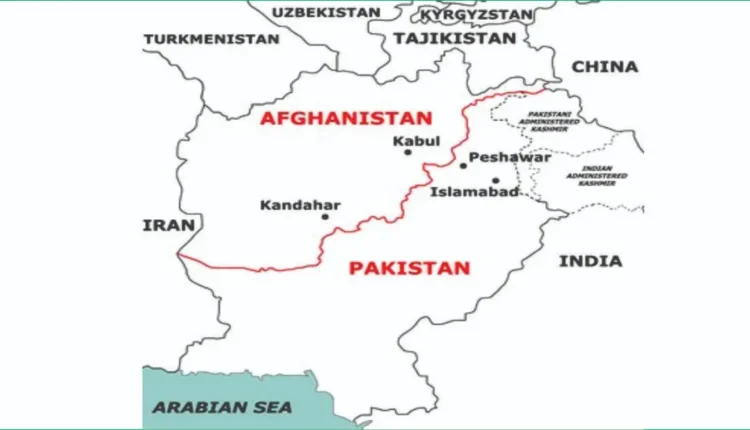
The Durand Line dispute between Pakistan and Afghanistan is an age-old issue that predates the partition of the Indian subcontinent and continues to influence relations between the two countries. Let’s understand it step by step:
1. Background of the Durand Line
Mortimer Durand – Abdur Rahman Agreement (1893)
In 1893, an agreement was signed between Sir Mortimer Durand, Foreign Secretary of British India, and Amir Abdur Rahman Khan of Afghanistan. This agreement demarcated the border between British India and Afghanistan, now known as the Durand Line, spanning approximately 2,640 km.
The agreement was valid only during the lifetime of Amir Abdur Rahman Khan. It also stipulated that Afghanistan could import arms via India, and the British government would provide the Afghan ruler an annual subsidy of 1.8 million rupees.
After the death of Amir Abdur Rahman, the agreement expired, and the British suspended the subsidy and corridor facilities until new arrangements were made.
Louis Dane – Habibullah Agreement (1905)
Sir Louis Dane, Foreign Secretary of British India, visited Kabul at the invitation of the new Afghan Amir Habibullah Khan. On March 21, 1905, an agreement was reached restoring the subsidy and corridor facilities. Amir Habibullah pledged full adherence to his father’s agreement.
Rawalpindi Agreement (1919)
After the Third Anglo-Afghan War, on August 8, 1919, Afghanistan’s Interior Minister Ali Ahmad Khan signed a peace agreement in Rawalpindi with Sir Hamilton Grant, Foreign Secretary of British India.
While Britain withdrew the subsidy and corridor facility, it formally recognized Afghanistan’s independence and sovereignty for the first time.
Clause 5 of the agreement stated:
“The Afghan government accepts the same boundary recognized by the late Amir Habibullah Khan between British India and Afghanistan.”
Thus, under the 1919 agreement, the Durand Line became an official international boundary, not limited to the ruler’s lifetime.
Kabul Agreement (1921)
On November 22, 1921, in Kabul, Sir Henry Dobbs, Foreign Secretary of British India, and Afghanistan’s Foreign Minister Mahmood Tarzi, representing King Amanullah Khan, signed a new agreement replacing the 1919 Rawalpindi Agreement.
Article 2 stated:
“Both parties accept the same boundary recognized under Clause 8 of the 1919 agreement.”
This agreement allowed either party to withdraw after three years, but neither the British nor Amanullah Khan did so. Afghanistan thus officially recognized the Durand Line as its border with British India.
King Amanullah’s successor, King Nadir Shah, wrote on July 6, 1930:
“We proudly declare that all previous agreements are not only ratified but are to be considered fully binding.”
2. Pakistan’s Position
At the time of Pakistan’s creation in 1947, under the international principle of uti possidetis juris (new states inherit former colonial boundaries), Pakistan recognized the Durand Line as its border with Afghanistan.
3. Afghanistan’s Position
At Pakistan’s independence, Afghanistan was the only country to oppose its UN membership, based on the border dispute.
Initially, Kabul did not reject the Durand Agreement, but in 1949, the Afghan Parliament passed a resolution stating it would “not recognize this border with Pakistan.”
Some Afghan leaders argue that since the Durand Agreement was between British India and Afghanistan, it ceased to exist after British India ended. However, this stance has remained verbal—Afghanistan has never raised the matter in the International Court of Justice.
Afghanistan also understands that any change in the eastern border could jeopardize its access to the Wakhan Corridor, so it seeks to maintain the corridor while including Khyber Pakhtunkhwa’s tribal areas to pursue the idea of a cross-border Islamic emirate.
4. Afghanistan’s Dual Policy
In the 19th century, borders between Afghanistan and the Russian Empire, and Afghanistan and Iran, were drawn by Britain and Russia without Afghan consent.
The Durand Line, however, was established with the Afghan ruler’s consent and was recognized by three Afghan kings over 37 years through five different agreements.
Yet, Afghanistan has never challenged its northern border (with former Soviet states) or western border (with Iran), repeatedly disputing only the Durand Line.
If Pakistan is not the successor of British India, what about Afghanistan’s northern border, now adjoining Tajikistan, Uzbekistan, and Turkmenistan?
5. Importance of the Wakhan Corridor
The Wakhan Corridor is a 350 km-long narrow and mountainous strip in northeastern Afghanistan, connecting Afghanistan to China and separating it from Pakistan’s border with Tajikistan. Its width ranges from 13 to 65 km.
During the 19th century “Great Game” between Britain (from the subcontinent) and Russia (from Central Asia), both powers avoided direct border contact. Under the 1895 agreement, the Wakhan Corridor was assigned to Afghanistan to serve as a buffer zone.
Geopolitically, the corridor is vital for:
- China: Provides an alternative trade route.
- Pakistan: Serves as land access to Central Asian countries.
- Tajikistan & Central Asia: Provides access to Pakistan and Gwadar Port.
- Afghanistan: The only land route to China.
Thus, despite not recognizing the Durand Line, Afghanistan is determined to maintain control over the Wakhan Corridor.
This explains why in December 2024, when rumors spread that Pakistan had taken control of the Wakhan Corridor, Afghan authorities strongly reacted and reaffirmed their commitment to defend their territorial sovereignty.